


Let’s be honest — if you’re a grandparent today, you’re watching your grandkids navigate a world that didn’t exist when you raised your own kids. Predators lurking in DMs, brutal comparison culture, bullying that follows kids home through their phones, feeds engineered to keep them scrolling for hours. It’s a lot. And it makes sense that you’d want to do something about it.
But here’s the tricky part: you’re not the parent anymore. You already raised your kids — now it’s their turn to make the calls, even the ones you might make differently. That can feel frustrating, especially when you can see a problem before anyone else seems to notice it.
The good news? You don’t need to be the one setting screen time limits or approving apps to make a real difference. Some of the most powerful protection you can offer has nothing to do with control and everything to do with connection — being the kind of steady, trusted presence a kid turns to when something feels off online. That’s what this list is really about: how to stay protective without stepping on toes.
1. Start With the Parents, Not the Kids
Here’s a mistake it’s easy to make with the best intentions: you spot something worrying — maybe your grandkid’s glued to an app you’ve never heard of, or you catch a comment that seems off — and your first instinct is to say something directly to them. Totally understandable. But going around the parents, even gently, can backfire fast.
Think about it from their side. If they find out you talked to their kid about screen time or “that app” without looping them in first, it doesn’t read as helpful — it reads as going behind our backs. And once that trust cracks, you actually lose influence, not gain it. Suddenly you’re the grandparent they have to manage, not the one they welcome input from.
So flip the order. Bring it to the parents first. And how you bring it up matters just as much as the fact that you did. There’s a big difference between:
- “I read something concerning about [app] and wanted to see what you think”
- “You really need to get that phone away from her”
The first invites a conversation. The second invites defensiveness. One treats them like the capable adults they are; the other treats them like they’re missing something obvious — which, fair or not, nobody likes to hear from their own parent.
And once you’ve raised it? Let it go. The actual decisions — how much screen time, which apps are allowed, what the privacy settings look like — those are theirs to make. Your job isn’t to win the argument. It’s to plant the seed and trust them to run with it.
2. Become Genuinely Tech-Literate
Let’s be real for a second — if your idea of social media is still “Facebook, where I see photos of my great-nephew,” it’s going to be hard to have a credible conversation about what your grandkids are actually dealing with. And they will clock it if you’re commenting on something you clearly don’t understand. Nothing shuts down a conversation faster than a kid thinking, “Grandpa doesn’t even know what this is.”
You don’t need to become a tech wizard. You just need to know enough to not sound completely out of the loop. That means knowing that Snapchat isn’t just a photo app, that TikTok isn’t just dance videos, that Discord isn’t a video game (well, sometimes it is, but stay with me). You don’t have to love these apps or even really enjoy them — you just need a basic sense of how they work and why kids are drawn to them.
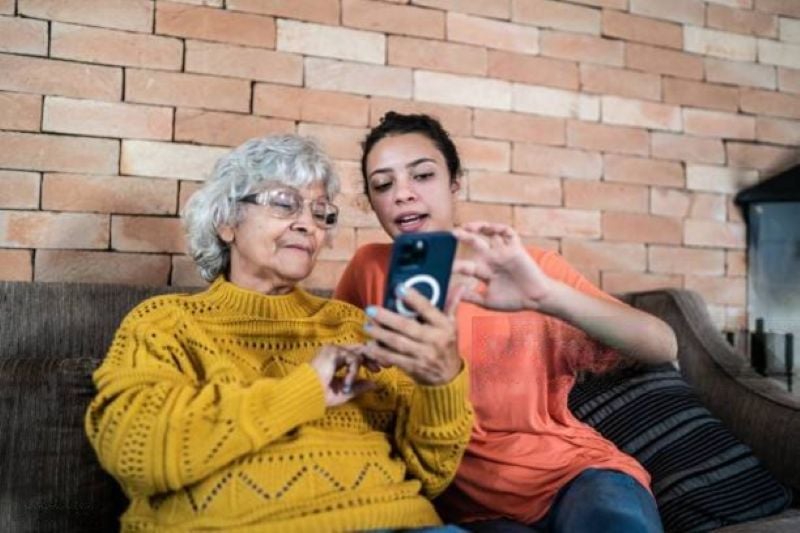
And here’s a fun trick: ask your grandkids to teach you. Seriously. “Hey, can you show me how this works? I want to understand what you’re into.” Most kids light up when you ask them to be the expert for once — it flips the usual dynamic where you’re the one explaining things to them. Suddenly you’re not the clueless grandparent lecturing about dangers you don’t understand. You’re just… curious. And curiosity opens doors that lectures never will.
The bonus? Once you actually understand the apps, your concerns carry way more weight — with both the parents and the kids. “I’ve been looking into Instagram and noticed…” lands very differently than “I don’t know what this Instagram thing is but I heard it’s bad.”
Read Also: 10 Simple Ways to Use Technology to Bond with Your Grandkids
3. Build a Relationship Where Grandkids Actually Talk to You
Here’s something worth sitting with: kids don’t usually go running to the adult who’s quickest to judge them. If a kid gets a scary message from a stranger, or sees something upsetting, or makes a mistake they’re embarrassed about — they’re going to go to whoever feels safest. Not whoever has the strictest rules. Whoever won’t make them feel small for bringing it up.
That’s actually huge news for grandparents, because you’re often perfectly positioned to be that person. You’re one step removed from daily discipline. You’re not the one grounding them or taking away their phone. If you can be warm, curious, and genuinely non-judgmental, you become exactly the kind of adult a kid will actually confide in when something goes wrong.
So how do you build that? It’s less about big gestures and more about consistency. Regular texts or calls — even just a “saw this and thought of you” meme or a quick “how’d the game go?”
Shared interests, even small ones, like following the same show or game. And maybe most importantly: resisting the urge to turn every conversation into a life lesson. Nobody, kid or adult, wants to feel like they’re walking into a lecture every time they pick up the phone.
Think of it this way — you’re not trying to be the fun grandparent who never says anything hard. You’re trying to be the safe grandparent, the one where nothing they tell you is going to result in immediate judgment or a call to mom and dad the second they hang up. That’s the person kids run to when something actually goes wrong online. And honestly? That’s worth more than any parental control app.
Read Also: 7 Simple Things Long-Distance Grandparents Can Do So Their Grandkids Never Feel Like Strangers
4. Model Healthy Tech Habits Yourself
Kids have a finely tuned radar for hypocrisy — and honestly, so would you if someone lectured you about your phone habits while scrolling through theirs mid-sentence. If you’re telling your grandkid that social media is a problem while you’re also glued to your own phone at dinner, texting through their soccer game, or checking Facebook every five minutes during a visit… they’re going to notice. And whatever you said next probably won’t land.
The good news is this one’s actually pretty simple, even if it takes a little discipline. Put the phone away during meals. Actually look up when they’re talking to you instead of half-listening while you scroll. Let them see that when you’re with them, you’re with them — not just physically present while your attention is somewhere else.
This isn’t about being perfect or never touching your phone again. It’s about showing, not telling, that real connection — a conversation, a shared laugh, actually being present — matters more than whatever’s happening online.
You don’t have to give a speech about it. Just live it in small, visible ways: leave the phone in another room, ask questions and actually wait for the answers, make eye contact instead of glancing at a screen. Kids absorb way more from what you do than what you say. If you want them to value real-world connection over likes and followers, be the proof that it’s possible.
Love Being a Grandma?

Join 33,762+ grandmas who wake up to a cheerful, uplifting email made just for you. It’s full of heart, sprinkled with fun, and always free. Start your mornings with a smile—sign up below! ❤️
5. Share Concerns as Stories, Not Rules
Nobody — kid or adult — loves being told what to do. But almost everybody loves a good story. That’s the loophole you can use here.
Instead of sitting your grandkid down with a warning (“Social media is dangerous and you need to be careful”), try bringing up something you read or saw — a news story, a documentary, even something that happened to a friend’s grandkid. “I saw this story about a girl who got a message from someone pretending to be a teenager, and it turned out to be an adult. That kind of scared me. Has anything like that ever come up for you or your friends?”
See the difference? You’re not accusing them of anything or assuming the worst. You’re just opening a door and letting them decide whether to walk through it. Kids are much more likely to engage with a story than a lecture, because a story doesn’t feel like it’s pointed at them — it feels like a conversation you’re having with them, not at them.
Asking questions instead of making statements does a lot of heavy lifting here too. “Have you seen anything like that?” or “What do you think about that?” invites them to actually talk, instead of just nodding along until you’re done. And it gives you real insight into what they’re actually experiencing online — which is honestly the whole point.
One thing to watch out for: fear-based messaging. If every conversation about social media sounds like a warning siren, kids tune it out fast — or worse, they stop telling you things because they don’t want the lecture that comes with it. Keep it curious, keep it calm, and let the story do the work instead of the scare tactic.
Read Also: 6 Simple But Impactful Ways a Grandmother Can Best Prepare for Her Grandkids’ Visit
6. Offer (Don’t Impose) Tools and Resources
Say you come across a great article about parental control apps, or you hear about some new feature that lets parents see who their kid’s been messaging. Your instinct might be to send it straight to your grandkid — after all, isn’t that the point? But hold on a second, because this is really a parents’ decision, not yours.
The move here is to pass it along to the parents, framed as a suggestion, not a directive. Something like, “Hey, I came across this app that a few parents have found helpful for managing screen time — thought I’d pass it along in case it’s useful” lands completely differently than “You should really be using this to monitor her phone.” One respects that they’re the ones in charge. The other implies they’re not doing enough, even if that’s not what you meant.
And here’s the part that’s genuinely hard: sometimes they’ll say no thanks, or they just won’t use it. That’s going to sting a little, especially if you feel strongly that it would help. But pushing past that “no” is exactly the kind of overstepping that damages trust and gets you cut out of the loop entirely. Better to be the grandparent who offered something useful and let it go, than the one who made an issue out of it.
Now, there is a gray area here — when is it okay to say something directly to your grandkid instead of routing everything through the parents? Generally, small stuff (an article you think is interesting, a general “how’s everything online going?” check-in) is fine to mention directly.
Anything that involves an actual rule, restriction, or tool? That goes through the parents first. When in doubt, ask yourself: am I sharing something, or am I trying to change something? Sharing, go ahead. Changing, loop in mom and dad.
Read Also: 12 Grandkid Behaviors That Grandmothers Should Rarely Blame Themselves For
7. Know the Warning Signs and When to Speak Up
This is the one where all that relationship-building really pays off — because it means you’re actually in a position to notice when something’s wrong.
Some signs are worth paying attention to: your grandkid suddenly pulling away from family or friends, being secretive about their phone in a way that feels different from normal teenage privacy, noticeable mood swings after being online, unexplained gifts or money showing up, or new “friends” you’ve never heard of who seem to have outsized influence. None of these automatically mean something’s wrong — kids are moody, private, and unpredictable by nature. But a pattern of these things together is worth paying attention to.
If you do notice something, the way you bring it to the parents matters enormously. This is not the moment for “Why haven’t you noticed this?” or “I can’t believe you let this happen.” That’s going to put them on the defensive immediately, and then the actual kid gets lost in the argument. Instead, try something like, “I’ve noticed she seems withdrawn lately, especially after she’s on her phone — have you noticed anything like that too?” You’re raising a concern, not filing a complaint.
Here’s the honest exception to everything we’ve talked about in this article: if you believe your grandkid is in immediate danger — genuine safety risk, not just a habit you disagree with — that’s the moment where stepping in directly, even without going through the parents first, is not just okay, it’s the right call.
Trust your gut here. Overstepping to protect a kid from something small (an app you don’t love, screen time you think is excessive) usually backfires. Overstepping because a kid might genuinely be in danger? That’s not overstepping at all. That’s just being the adult who showed up when it counted.
Final Thoughts
If there’s one thing to take away from all of this, it’s that you don’t need control to be protective. In fact, chasing control — trying to set the rules, monitor the apps, override the parents’ decisions — is usually the thing that backfires and pushes you further away from the very kid you’re trying to look out for.
What actually works is influence. And influence comes from connection, not correction. It comes from being the grandparent who asks good questions instead of delivering lectures, who’s genuinely curious instead of quick to judge, who shows up consistently instead of only surfacing when there’s a problem to fix. It’s slower than just laying down the law. It’s less satisfying in the moment. But it’s the thing that actually sticks.
Here’s the honest truth: you can’t control what app your grandkid downloads or what shows up in their feed. That’s not your job, and trying to make it your job usually just gets you shut out. But you absolutely can control what kind of adult you are to them — whether you’re someone they trust, someone they’d actually tell if something went wrong, someone who makes them feel safe instead of scrutinized.
That relationship? That’s the real protection. Not a filter, not a rule, not a parental control app. Just you, being someone they can count on. Turns out that’s still the most powerful thing a grandparent has to offer — it always has been.
Love Being a Grandma?
Join 33,762+ grandmas who wake up to a cheerful, uplifting email made just for you. It’s full of heart, sprinkled with fun, and always free. Start your mornings with a smile—sign up below! ❤️